How to choose the right output for a wood-burning stove or fireplace insert
More kilowatts doesn’t mean more comfort. How to work out the output your room really needs – and why it pays to get it as close as possible.
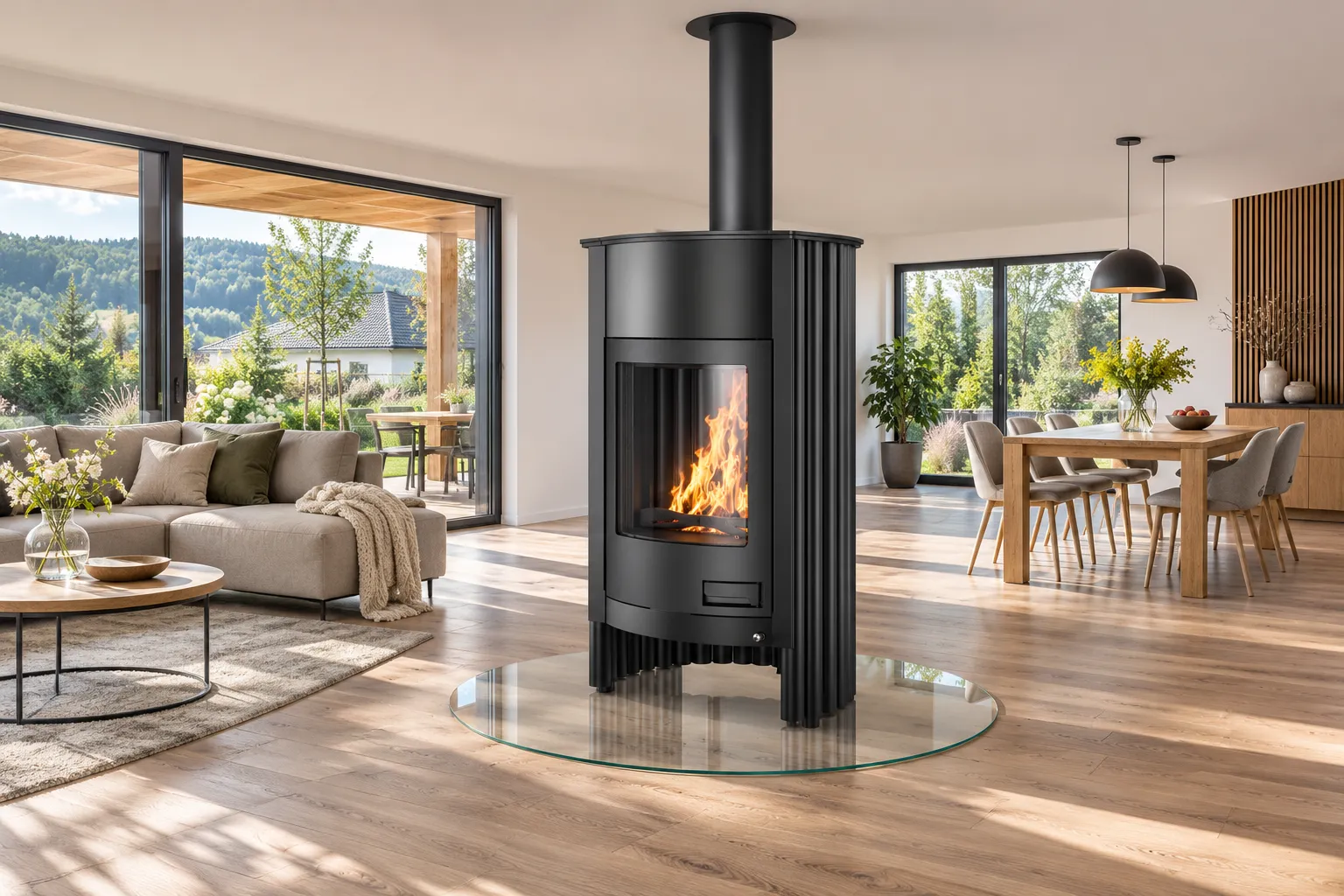
Output is the first figure we look at when choosing a stove – and also where most mistakes are made. A stove that is too powerful for the room can’t be run comfortably. One that is too weak simply won’t heat it.
Why “bigger to be safe” is a bad idea
An oversized stove quickly overheats the room. The owner then closes down the air supply, the fire is starved and the wood burns incompletely. The result is tar in the stove and the chimney, blackened glass and higher wood consumption.
An undersized stove runs flat out all the time. The structure is under more strain, firebox parts wear faster – and in freezing weather it still isn’t warm.
A stove works best when it spends most of its time at its nominal output – with the air reasonably open and a clean flame.
A rough calculation
For a first idea, a simple formula is enough:
volume of the heated space (m³) × heat loss (W/m³) = required output (W)
| Type of building | Approximate heat loss |
|---|---|
| Low-energy, well-insulated house | 23 W/m³ |
| Moderately insulated house | 35 W/m³ |
| Uninsulated house, old windows | 50 W/m³ |
| Holiday home | 80 W/m³ |
Example: an open-plan living room and kitchen of 60 m² with a 2.6 m ceiling has a volume of 156 m³. In a moderately insulated house that gives 156 × 35 = 5,460 W, so a stove with a nominal output of around 5–6 kW. In an uninsulated space of the same size it would be about 8 kW.
Our output calculator will work it out faster.
What the calculation doesn’t take into account
- Connected spaces. An open staircase or gallery carries heat upstairs – count the whole volume the heat flows into.
- What the stove is for. A stove that supplements a gas boiler needs a different output from one that is meant to heat all day.
- The chimney. The stove’s output must also suit the chimney you connect it to. A chimney sweep will assess the draught and diameter.
An exact figure comes from a heat-loss calculation by a building designer or heating engineer. For new builds you will usually find it in the project documentation.
Warm-air or boiler stove?
Warm-air stoves heat the room they stand in and, with warm-air distribution, neighbouring rooms too. They work well as a secondary heat source and for holiday cottages. You will find them among our Flamingo wood-burning stoves and Masterflamme.
Boiler stoves and inserts transfer most of their output to water and heat the whole house through radiators or underfloor heating. With these, the output to water is what matters most. The Aquaflam range comes in 7, 12, 17 and 25 kW versions. Find out more in our article Central heating with a boiler stove.
Not sure? Write or call us – we’ll advise you straight from the factory. You’ll find our contact details here.