Description
Heating several rooms from a single heat source by means of warm-air distribution was already known to the ancient Greeks, Romans and Koreans. The economic advantages of this way of heating are obvious — it is always more efficient to use one heat source for several places, especially if you can control where the heat goes, how much of it goes there and at what temperature.
Remember that:
- The heat output of the fireplace (fireplace insert) must always be sufficient, depending on whether you will use the fireplace as your main heating or only as supplementary (background) heating.
- There must be a sufficient air supply to the room from which the ducting runs and where the fire burns in the fireplace insert.
- Except in the very simplest warm-air distribution set-ups (for example, an air outlet only to the upper floor), a fan of the required capacity must be fitted in the system.
- All warm-air outlets must be closable and, if possible, continuously adjustable, so that you can always heat only the rooms you really want to heat.
- If you blow air into a room, you must also make sure the cooled air has a way to return. Slight overpressure does no harm; however, if the room were completely sealed (for example by uPVC windows and doors), it would not be possible to deliver the required amount of warmed air into it.
PARKANEX
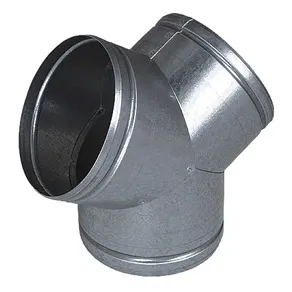
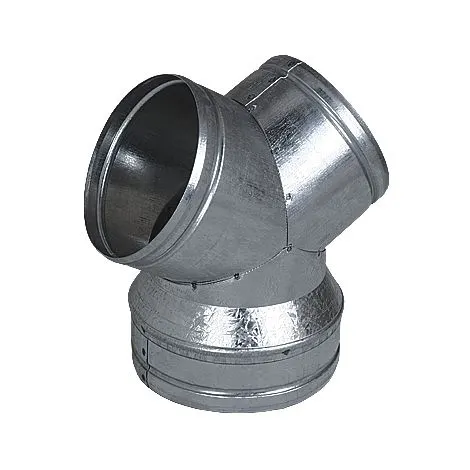
T-splitter 160mm, galvanised
Code: HSF18-085
The T-type splitter distributes warm air from one outlet into two distribution branches. Size 160mm, galvanised.
€11
incl. VAT
✓ Dispatched within 24 hours✓ 2 years warranty✓ Free advice
- The heat output of the fireplace (fireplace insert) must always be sufficient, depending on whether you will use the fireplace as your main heating or only as supplementary (background) heating.
- There must be a sufficient air supply to the room from which the ducting runs and where the fire burns in the fireplace insert.
- Except in the very simplest warm-air distribution set-ups (for example, an air outlet only to the upper floor), a fan of the required capacity must be fitted in the system.
- All warm-air outlets must be closable and, if possible, continuously adjustable, so that you can always heat only the rooms you really want to heat.
- If you blow air into a room, you must also make sure the cooled air has a way to return. Slight overpressure does no harm; however, if the room were completely sealed (for example by uPVC windows and doors), it would not be possible to deliver the required amount of warmed air into it.
Drawings and dimensions
Downloads
Manufacturer
Parkanex